
As the power industry grapples with increasing demands for efficiency, resilience, and sustainability, digital twin technology has emerged as a game-changing innovation. By creating virtual representations of physical systems, digital twins enable a new level of insight, control, and optimisation.
For electrical engineering design consultancies, digital twins offer a powerful tool for simulating, analysing, and enhancing power systems across their entire lifecycle. This article explores the benefits and applications of digital twin technology in power systems, illustrating how it transforms the way we approach design, operations, and maintenance in the energy sector.
What is Digital Twin Technology?
A digital twin is a virtual model of a physical asset, process, or system, created to simulate real-world conditions and interactions. In power systems, this means developing digital replicas of infrastructure such as substations, transformers, and distribution networks. Using sensors, IoT devices, and advanced analytics, these digital twins continuously receive data from their physical counterparts, providing up-to-date insights into system performance, potential failures, and optimisation opportunities.
For design consultancies, the value of digital twins lies in their ability to simulate complex scenarios, allowing engineers to anticipate and address issues before they occur. By integrating real-time data and predictive analytics, digital twins enable a proactive approach to design and maintenance, ultimately reducing costs, minimising downtime, and ensuring optimal performance.
Benefits of Digital Twin Technology in Power Systems
The adoption of digital twins offers several distinct advantages, particularly in power system design and management:
1. Enhanced System Design and Simulation
Digital twins allow design consultancies to create detailed virtual models of power system components, from electrical infrastructure to entire grid layouts. Engineers can simulate various configurations, load scenarios, and environmental conditions to find the most efficient design solution. For instance, a consultancy working on a substation can use a digital twin to optimise the arrangement of components for better cooling, reduced electrical losses, and improved accessibility. Simulating these factors digitally avoids costly trial-and-error in the field, streamlining the design process and delivering better outcomes for clients.
2. Improved Operational Efficiency and Maintenance
Once deployed, digital twins continue to provide value by enabling real-time monitoring and predictive maintenance. By analysing data from sensors on the physical asset, digital twins can forecast when maintenance is needed, identify components at risk of failure, and optimise resource allocation for repairs. This predictive capability not only extends asset lifespan but also minimises unplanned downtime. For clients, this means lower operational costs and a more resilient power system. For design consultancies, it’s an opportunity to provide ongoing value through proactive maintenance planning and system optimisation.
3. Risk Mitigation and Resilience
Digital twins empower consultancies to simulate and prepare for potential disruptions, such as equipment malfunctions, demand surges, or extreme weather events. These simulations help identify vulnerabilities within the power system and guide preventive measures, such as adjusting load distribution or reinforcing critical infrastructure. With climate conditions becoming more unpredictable, this ability to model and enhance resilience is particularly valuable in Australia’s power sector. By proactively addressing risks through digital twins, design consultancies can offer clients a more robust and adaptable infrastructure, better prepared to handle unexpected events.
4. Enhanced Data-Driven Decision-Making
Digital twins generate vast amounts of data, providing consultancies and their clients with actionable insights into system performance and optimisation opportunities. Advanced analytics enable design teams to make data-driven decisions regarding equipment upgrades, design changes, and resource allocation. For example, by analysing data from a digital twin, a consultancy can determine that upgrading a particular substation’s components will significantly improve reliability and reduce energy losses. This data-driven approach allows consultancies to present clients with clear, quantifiable benefits, making the case for investments in system improvements.
Key Applications of Digital Twin Technology in Power Systems
Digital twin technology is applicable across various stages of power system design and management. Here are a few specific use cases that demonstrate its versatility:
Substation Design and Optimisation
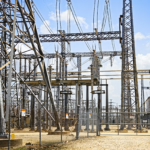
Creating digital twins of substations allows design engineers to test different layouts and configurations to optimise for space, accessibility, and efficiency. Engineers can model electrical, mechanical, and thermal interactions to identify potential issues like hot spots, voltage drops, or clearance violations. This approach results in designs that are more efficient, reliable, and aligned with regulatory standards, reducing the likelihood of costly redesigns or retrofits.
Grid Stability and Load Balancing
In an era of increasing renewable energy integration, grid stability and load balancing are critical. Digital twins provide a platform for simulating the impact of variable energy sources like solar and wind on the grid. By running these scenarios, engineers can assess grid stability and devise strategies to smooth out fluctuations. For clients, this means a more resilient grid that can handle higher penetrations of renewable energy without compromising reliability.
Predictive Maintenance and Lifecycle Management
For equipment-intensive sectors like power, asset maintenance is both costly and crucial. Digital twins enable predictive maintenance by continuously monitoring asset health, flagging potential failures before they occur. This application is particularly valuable for remote or hard-to-access infrastructure, where unplanned maintenance can be logistically challenging. Predictive maintenance supported by digital twins helps clients achieve better asset longevity and lower maintenance costs, reinforcing the consultancy’s value proposition.
Training and Scenario Testing
Digital twins also provide an excellent platform for training new engineers and testing scenarios in a safe, controlled environment. Engineers can use digital twins to explore complex systems, simulate emergency responses, and gain hands-on experience without risking real-world disruptions. This capability is valuable not only for internal training but also for clients seeking to upskill their teams in operating and managing digital infrastructure.
The Future of Digital Twin Technology in Power Systems
As digital twin technology evolves, its applications in power systems will continue to expand. The convergence of digital twins with artificial intelligence (AI) and machine learning (ML) will enable even more sophisticated predictive models, enhancing system efficiency and resilience. Additionally, as Australia’s power sector increasingly focuses on sustainability, digital twins can play a vital role in optimising energy use, integrating renewable sources, and reducing carbon emissions.
For electrical engineering consultancies, adopting digital twin technology offers a distinct advantage in an increasingly competitive market. By leveraging digital twins, consultancies can deliver smarter designs, improve operational outcomes, and build lasting relationships with clients based on ongoing, data-driven support. The result is not just better projects, but a stronger, more adaptive power infrastructure capable of meeting Australia’s evolving energy needs.
Digital twin technology is transforming power systems by providing unprecedented visibility, control, and optimisation capabilities. For electrical engineering consultancies, digital twins represent an opportunity to lead the charge toward a more efficient, resilient, and sustainable power sector. By embracing this technology, consultancies can deliver value at every stage of a project, from design and deployment to ongoing maintenance and optimisation. As the power industry advances, digital twins will undoubtedly play an essential role in shaping the future of energy.